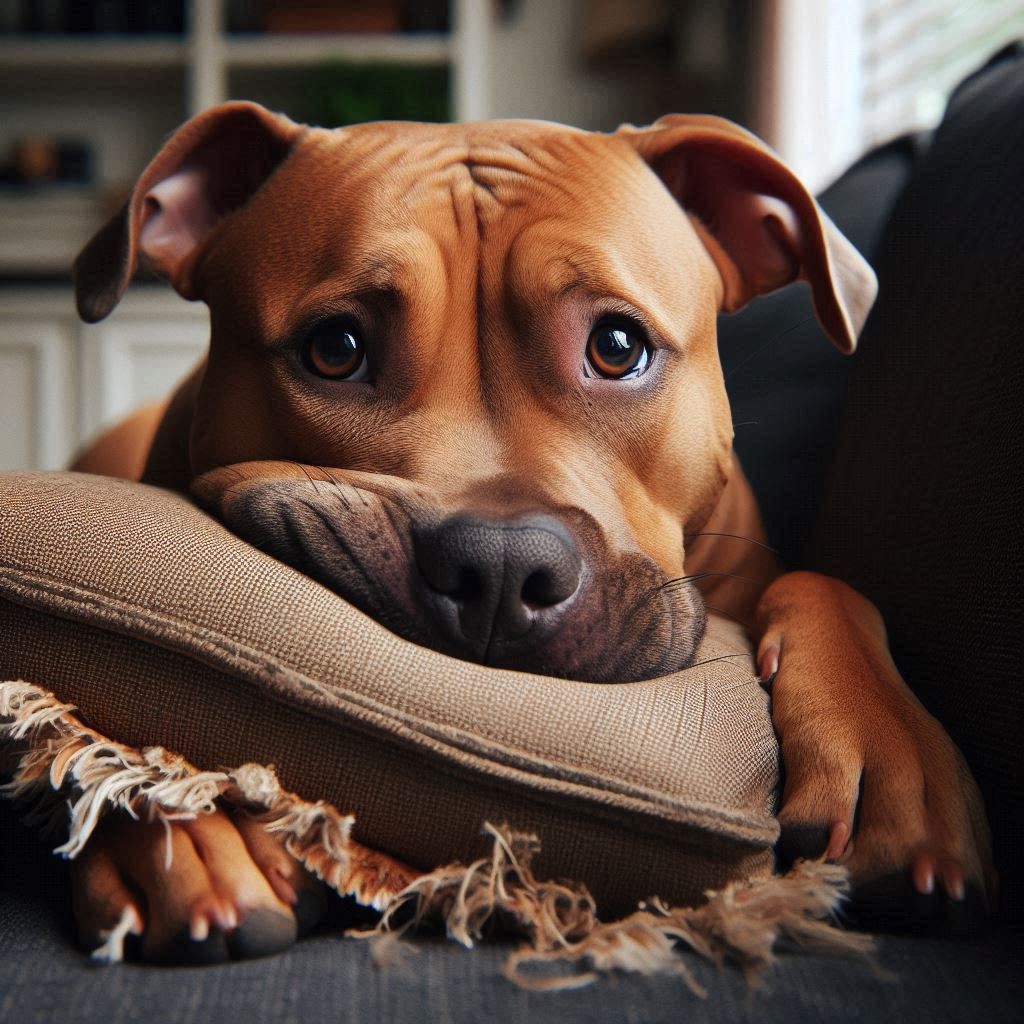
If you’re trying to stop a Pit Bull chewing you should first recognize that chewing is a very natural and expected behavior, especially in a puppy.
Pit bulls are going to chew on things for various reasons whether they are teething, playing, or simply seeing what they are capable of. It’s not a matter of actually stopping that chewing, but redirecting it.
Getting their daily exercise along with an array of chew toys will keep them occupied with doing what they should be doing instead of chewing up your couch.
Why Pit Bulls Chew So Much
Chewing is natural for every dog, and pit bulls have a few extra reasons to be enthusiastic chewers. Understanding why your dog chews points you toward the fix that will actually work, because a teething puppy, a bored adolescent, and an anxious adult all need different solutions.
Teething is the first big reason. Pit bull puppies begin losing their baby teeth somewhere around three to four months of age, and the adult set is usually in by six to seven months. During those months their gums are sore and chewing brings relief. If your puppy is under a year old and chewing everything in sight, teething is almost certainly part of the story.
Breed drive is the second. Pit bull–type breeds were developed from dogs bred for gripping and holding, so a powerful jaw and a strong urge to use the mouth are built into the breed. Chewing is a breed-typical outlet for that energy, and trying to eliminate it entirely is a losing battle. The goal is to give that drive a legal target.
Boredom is the third, and it is the most common cause of destructive chewing in adult pit bulls. These are athletic, intelligent dogs that need both physical exercise and mental work every day. An under-exercised, under-trained young pit bull will invent its own entertainment, and the entertainment is usually your furniture, shoes, drywall corners, or fence boards.
Anxiety and stress come fourth. Some dogs chew to soothe themselves when they are worried. Separation anxiety is a classic cause: the dog is fine all evening, then destroys the door frame or the couch cushions the moment everyone leaves. Chewing that is concentrated on exit points like doors and window frames, or that comes with pacing, drooling, and howling, is telling you something different from ordinary boredom chewing.
Finally, young dogs explore the world with their mouths the way toddlers explore with their hands. Mouthing, tasting, and testing objects is how a puppy learns, so some of this behavior simply has to be managed and outgrown.
Stop Pit Bull Chewing Early
Whether you have a Pit Bull Puppy or an older dog, the quicker your action to stop your dog chewing, the easier it will be to achieve results. There are a few methods you can try to go with, whichever one works best for you.
Yelling or hitting your pit bull is not a good idea for any reason even if they just chewed up your brand new shoes. It can be aggravating for sure but more than likely they will be confused by your behavior and probably end up doing it again.
A pit bull puppy can be injured easily and an adult pit bull can endure pain more than other breeds. You will end up not hurting your pit bull or overdoing it and seriously injuring them because of their higher threshold for pain. Either way, this method is highly inappropriate as well as ineffective.
Redirection – Instead of trying to stop your pit bull from chewing on your things, teach it to chew on the right things. When you catch your pit bull chewing on a slipper, get the Pit’s toy, replace it and then praise your dog when it starts chewing on the new toy. This will teach your puppy that the new item is good and the old one is not.
Make redirection work by setting it up in advance. During the training months, keep an approved chew toy within arm’s reach in every room so a swap is always possible. Play the trade game: offer the toy, and the moment your dog drops your item and takes the toy, praise and reward. Teach a “drop it” cue separately with food rewards so you have a word for the trade instead of a tug-of-war. And never chase your dog to get something back. To a young pit bull, being chased while holding a stolen shoe is the greatest game ever invented, and chasing teaches them to run away and chew faster. Stay calm, make the legal toy more exciting than the stolen item, and trade.
Exercise – To stop your pit bull chewing, make sure they are getting their daily dose of exercise. Even when they are not teething, a puppy will chew to keep active.
Daily exercise is not only good for them but it tires them out making them less likely to be chewing and more likely to be resting. If outdoor exercise is not available for whatever reason, make sure they have various stimulating toys that will keep them busy.
Mental work tires a dog out just like physical work does. Food puzzles, frozen stuffed toys, snuffle mats, and ten-minute training sessions on basic cues all count as enrichment, and a dog whose brain is tired is much less interested in redesigning your couch. Rotate your dog’s toys every few days, putting some away and bringing others back, because novelty makes old toys interesting again and keeps your dog’s attention on the legal options.
Crate Training – If your pit bull gets into your things when you’re not home, crate training may be necessary so they have limited access to the home.
You can even keep your pit bull in a single room while you’re away to limit their access, but the goal here should be the same.
Puppy-Proofing Your Home
You cannot train a behavior your dog never gets to rehearse. While your pit bull is still learning the rules, manage the environment so the wrong choices are simply not available. Pick up shoes, put laundry in hampers with lids, secure trash cans, cover or raise electrical cords, and keep remotes, eyeglasses, and anything small enough to swallow out of reach. Use baby gates to block off rooms that are not puppy-safe. Do not forget the yard: fence boards, pool equipment, garden tools, and irrigation lines are all tempting targets for a determined young chewer. Supervise closely for the first six months or more, because every successful theft of a forbidden item teaches your dog that forbidden items are the best toys.
Choosing Appropriate Chew Outlets
Give your pit bull legal things that are actually worth chewing. Sturdy rubber chew toys in a size made for strong-jawed breeds are the workhorses of a chew program. Keep three or four in rotation and freeze food or broth inside some of them so the dog has to work for it. Long-lasting edible chews can help too, but skip cooked bones, anything that splinters, and anything small enough to be swallowed whole. Supervise all chewing, especially with a powerful chewer, and retire any toy that starts breaking into pieces before your dog can ingest them. Match the outlet to the dog: a teething puppy often likes softer things it can really sink its gums into, while a bored adult needs something that stands up to a serious jaw.
Aversion Sprays – To stop your pit bull from chewing on things like your rug or couch cushions, use a safe humane spray like Bitter Apple or Cayenne Pepper that does not taste good to them.
They will quickly associate those items with a bad taste that will keep them from chewing there.
Consistency – If you really want to stop your pit bull chewing, make sure you are consistent in all of your actions. Don’t let your Pit chew on a slipper or a sock or a stuffed animal as a toy and then expect them to know which clothes or stuffed animals are okay and which are not okay.
As the owner, lay down strict rules and follow them. Your dog will learn quickly enough and the chewing will be far less of a problem.
When Chewing Signals a Bigger Problem: Separation Anxiety
Most chewing responds to exercise, enrichment, and redirection within a few weeks. But some dogs chew because they are panicking when left alone, and no amount of extra chew toys will fix panic. Watch for the pattern: the dog is relaxed and well-behaved while you are home, but destroys things, especially near doors and windows, only during absences. Other signs include pacing before you leave, drooling, howling, house-soiling despite being house-trained, and frantic greetings when you return.
If this pattern fits your dog, the chewing is a symptom, not the root problem, and you will make faster progress by addressing the anxiety itself. Our guide to separation anxiety in pit bulls walks through the first steps: desensitizing your departure cues, keeping arrivals and departures boring, building up alone time gradually, and providing calm mental work before you leave. Severe cases, where the dog injures itself trying to escape, deserve professional help from a certified trainer or veterinary behaviorist, because some dogs need a structured behavior-modification plan to learn that being alone is safe.
A Plan for Destructive Chewing
Put it all together and destructive chewing becomes a solvable management project rather than a mystery. First, meet your dog’s exercise needs every single day, adding mental work like training sessions and food puzzles on top. Second, provide legal chew outlets and rotate them so they stay interesting. Third, puppy-proof the house and manage access with a crate or a single safe room whenever the dog is unsupervised. Fourth, redirect in the moment, teach a “drop it” cue, and reward your dog for choosing the right items. Fifth, keep the rules identical for every person in the household so your pit bull gets a consistent message.
Finally, rule out medical causes when the pattern changes suddenly. A dog that starts chewing its own paws or skin, swallowing non-food items obsessively, or chewing destructively out of nowhere deserves a veterinary check, because pain, skin irritation, digestive upset, or nutrient gaps can all drive strange chewing. Fix the cause, manage the environment, and redirect with patience, and your pit bull’s powerful jaws will stay busy on things you actually approve of.